A Technology Palette

Technologies selected and integrated based on suitability — not on any single product in isolation.

The technologies below are tools used to deliver integrated, high-performance building services. Selection is based on suitability, constraints and how each technology interacts with the wider system.

Air Source Heat Pumps

Reliable, low-carbon heating and hot water

Air source heat pumps extract low-grade heat from the outside air and upgrade it for use in space heating and domestic hot water. They are most effective when paired with low-temperature heat distribution systems and well-considered building fabric.

ASHP systems are typically suited to properties with moderate heat demand, sufficient external space for equipment, and electrical supplies capable of supporting peak loads. Careful attention is paid to acoustic performance, defrost cycles, and integration with thermal storage to ensure stable and efficient operation.

  • Low-carbon space heating and hot water
  • Effective with low-temperature underfloor heating
  • Can provide active cooling in summer
  • Suitable for new builds and retrofits
  • MCS-compliant installation as standard
Air source heat pump installation
Ground Source Heat Pumps

High seasonal efficiency from stable ground temperatures

Ground source heat pumps use energy stored in the ground via boreholes or ground loops to provide heating and hot water with very high seasonal efficiency. Because ground temperatures remain relatively stable throughout the year, GSHP systems offer consistent performance in both winter and summer.

These systems are typically selected where site conditions allow for groundworks and where long-term operational efficiency is prioritised. Design considerations include borehole spacing, ground conditions, available land area and integration with thermal storage.

  • Higher seasonal efficiency than air source
  • Consistent performance year-round
  • Borehole or horizontal ground loop options
  • Excellent for larger properties and pools
  • Active cooling capability in summer
Ground source heat pump borehole installation
Underfloor Heating & Heat Distribution

Even heat distribution at low flow temperatures

Underfloor heating is commonly used to support low-temperature heat pump operation, providing even heat distribution and stable internal conditions. It operates with lower flow temperatures than traditional radiators, improving overall system efficiency.

Design considerations include floor build-up, thermal mass, zoning strategy and response times. In refurbishment projects, underfloor heating may be combined with alternative emitters where constraints exist. Correctly designed heat distribution systems play a critical role in comfort, efficiency and system longevity.

  • Low flow temperatures — ideal for heat pumps
  • Even heat distribution across floor area
  • Can be cast into structural slab for thermal mass
  • Zoning for different temperature requirements
  • Compatible with screed and dry systems
Underfloor heating installation
Mechanical Ventilation with Heat Recovery

Fresh air and heat recovery in one quiet system

MVHR systems provide continuous, controlled ventilation while recovering heat from extracted air. They are particularly effective in airtight buildings, where unmanaged ventilation would otherwise lead to heat loss and poor air quality.

Design focuses on airflow rates, duct routing, noise control and filtration, ensuring systems operate quietly and efficiently. Integration with heating and cooling strategies is considered from the outset to avoid conflicts and unnecessary energy use.

  • Continuous fresh filtered air supply
  • Heat recovery from extracted air — up to 90%
  • Humidity control and allergen filtration
  • Quiet operation by design
  • Can incorporate summer bypass and cooling
MVHR mechanical ventilation with heat recovery
Solar Photovoltaics (PV)

On-site electricity generation for low-carbon operation

Solar PV systems generate electricity on site, reducing grid dependence and supporting low-carbon operation. System sizing is based on available roof or land area, orientation, shading, and the property's electrical demand profile.

Rather than maximising installed capacity, PV systems are typically sized to work effectively with on-site consumption and storage. Integration with heat pumps, battery storage and diverters is considered to improve self-consumption and overall system efficiency.

  • In-roof and on-roof mounting options
  • Ground-mounted arrays for larger sites
  • Sized to complement demand and storage
  • Diverter integration for surplus generation
  • Architecturally considered on heritage properties
Solar PV panel installation
Battery Storage

Store surplus generation, reduce grid dependence

Battery storage systems allow surplus electricity to be stored for later use, improving self-consumption of on-site generation and reducing peak grid imports. They can also provide resilience during grid interruptions, depending on system configuration.

Design considerations include storage capacity, charge/discharge rates, inverter selection and integration with other electrical loads. Oversizing storage can deliver diminishing returns, so capacity is matched carefully to generation and usage patterns.

  • Maximises solar PV self-consumption
  • Peak grid import reduction
  • Grid resilience and backup capability
  • Compatible with EV charging schedules
  • Scalable capacity matched to demand
Battery storage system
Controls & Energy Management

Reliable performance with minimal complexity for the user

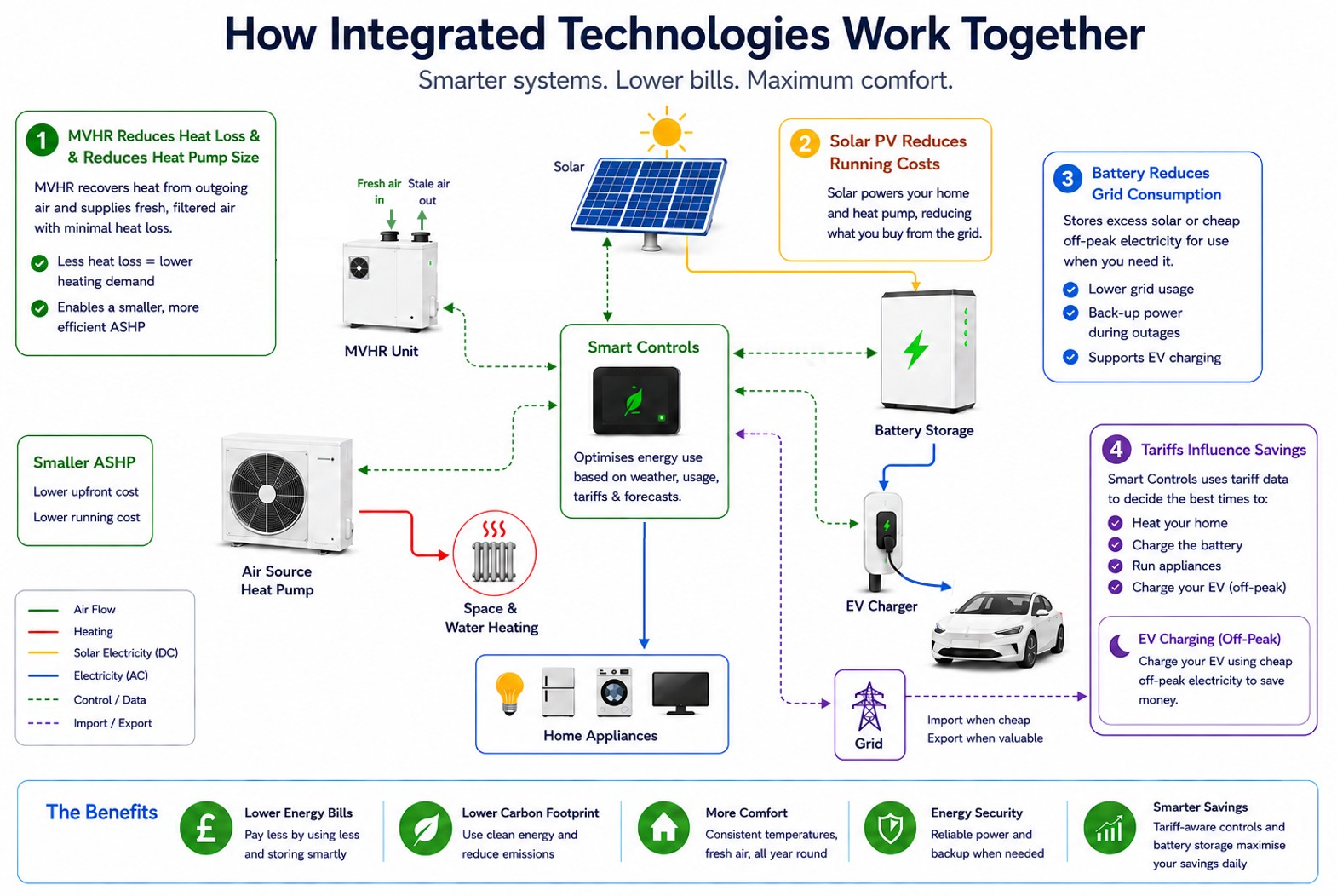
Controls and energy management systems coordinate how heating, ventilation, generation and storage operate together. The objective is to achieve reliable performance with minimal complexity for the user.

Control strategies are selected to support system interaction, load shifting and efficient operation rather than excessive automation. Clear zoning, sensible setpoints and intuitive user interfaces are prioritised. Well-designed controls underpin long-term performance and user satisfaction across the entire system.

  • System coordination and load scheduling
  • Intuitive user interfaces
  • Remote monitoring and diagnostics
  • Tariff-based optimisation (off-peak charging)
  • Heating zone and setpoint management
Energy management controls and monitoring

Technology alone does not deliver performance

The effectiveness of each system depends on how it is selected, sized and integrated within the building as a whole. We take responsibility for that integration on every project.

Discuss Your Project