Ventilation & Air Quality
Continuous Fresh Air
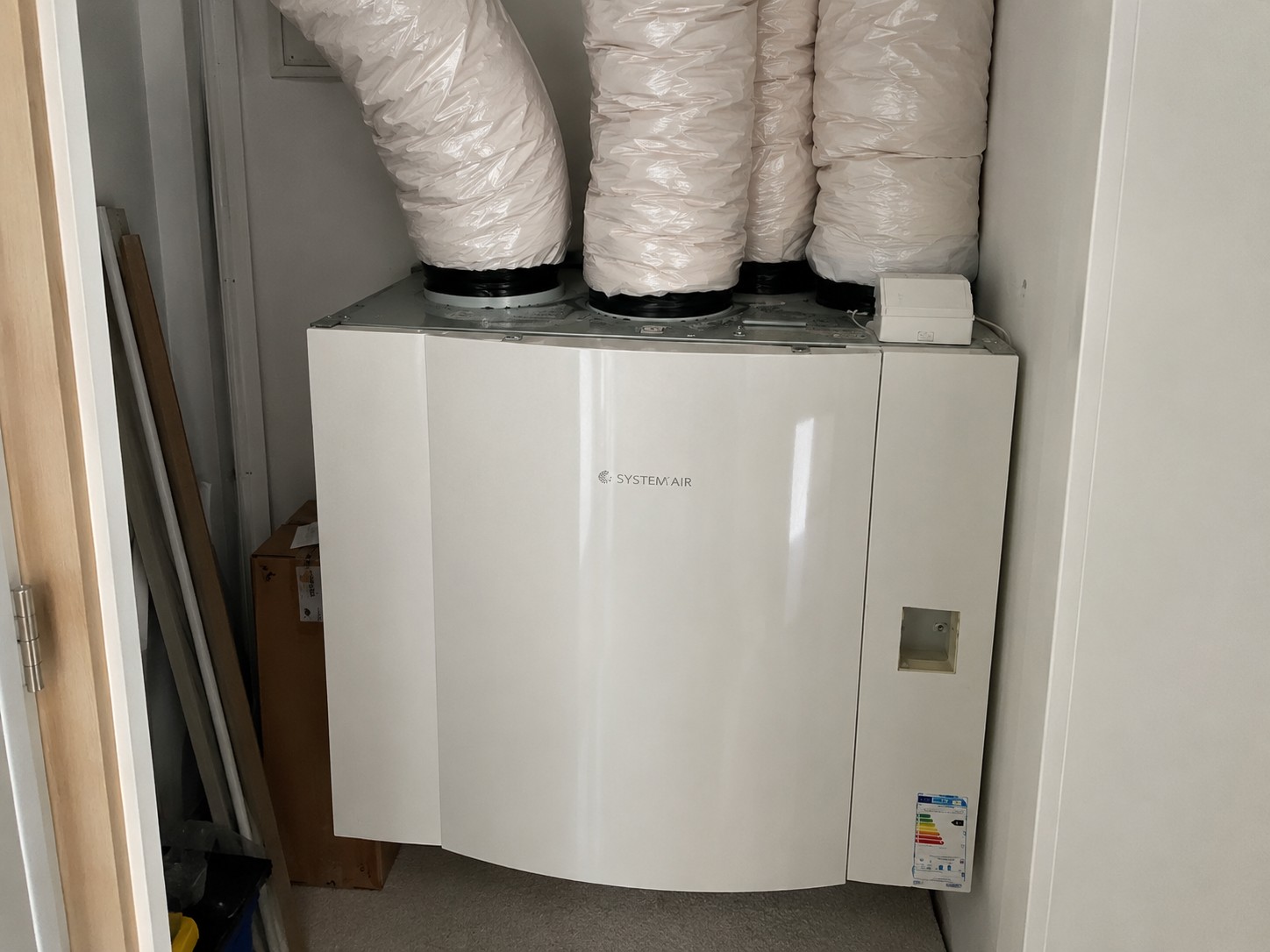
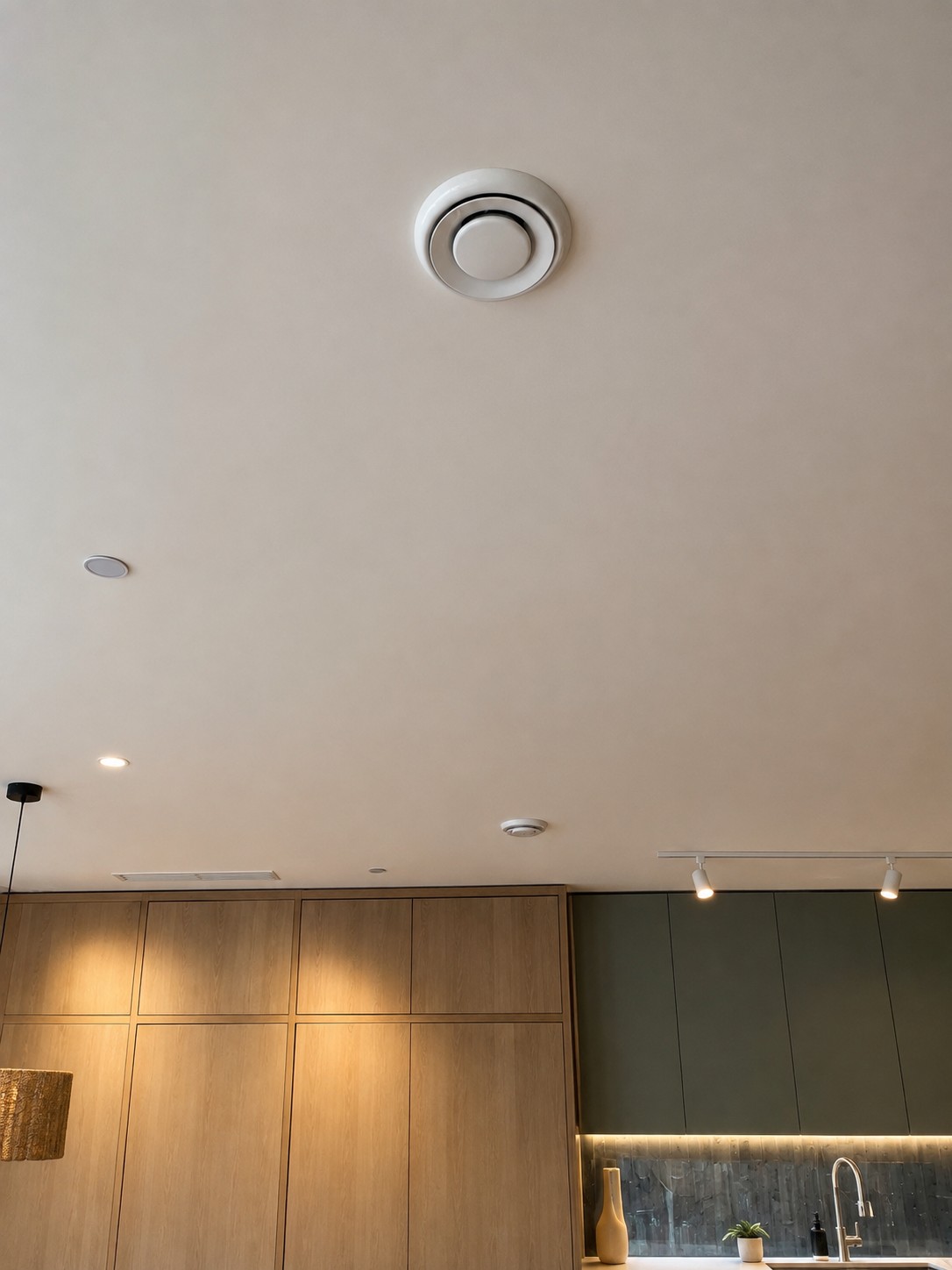
Mechanical ventilation with heat recovery (MVHR) provides a continuous supply of filtered fresh air throughout the home. Stale and moisture-laden air is extracted from bathrooms, kitchens and utility rooms, while fresh air is supplied to bedrooms and living spaces.
Before the extracted air leaves the property, much of its heat is transferred to the incoming fresh air without mixing the two air streams. This helps reduce ventilation heat loss while supporting indoor air quality, comfort and humidity control. Where a heat pump is also proposed, the MVHR system is accounted for within the property's heat-loss calculation as it can reduce the heat pump size and therefore running costs.
Quiet, Balanced Ventilation
A complete MVHR design considers:
- The airflow required in each room
- The location of the MVHR unit
- Supply and extract duct routes
- Intake and exhaust positions
- Acoustic performance
- Condensate drainage
- Access for filter changes and servicing
New Builds and Renovations
MVHR is particularly suited to airtight new builds and major renovations, where the unit and ductwork can be coordinated before walls and ceilings are closed. Retrofitting is also possible, but suitable routes and the likely disruption must be assessed first.

MVHR Installers Across Dorset and the South
PowerNaturally provides MVHR design, installation, airflow balancing, commissioning and servicing across Dorset, Somerset, Hampshire and Wiltshire.
Choosing with Confidence
Five useful questions to ask when comparing MVHR quotations, proposals and system designs.
Question 1Is MVHR suitable for the property?
MVHR is most effective in well-insulated, airtight homes where stale air needs to be removed without losing unnecessary heat. It is especially useful in new builds, major renovation projects and homes with condensation, humidity or indoor air quality concerns.
For MVHR to work well, the property needs suitable space for the unit, clear duct routes and good airtightness. If too much air leaks through gaps in the building, the system will be less effective.
MVHR can be retrofitted, but it needs careful planning. The quote should explain where the unit will go, how ducts will reach each room and any requirements, such as boxing-in for ductwork. A good proposal should ensure that the system has been designed around the property, not just selected by floor area.
Question 2Has the ductwork been designed, rather than simply routed?
MVHR ductwork should be designed, not just fitted wherever there is space. The design should show how much air will be supplied to or extracted from each room, where the terminals will be positioned and how the ductwork will reach them.
There are different suitable approaches, including rigid branch systems and smooth semi-rigid radial systems. Either can perform well when it is correctly sized and installed.
Long runs, tight bends, undersized ducts and excessive flexible ducting can increase resistance, noise and energy use. For larger or more complex properties, duct layouts and airflow calculations should be available as part of the supporting design information.
Question 3How has noise been controlled?
A properly designed MVHR system should operate quietly at its normal background ventilation rate. Noise is influenced by the position of the unit, the ductwork design, air velocities and the system's commissioning - not simply the manufacturer's headline airflow figure.
The important consideration is how hard the unit will need to work once connected to the complete duct system. A larger unit operating gently may be quieter than a smaller unit working close to its limit, although this depends on the overall design.
If noise is a particular concern, such as the unit being located near bedrooms or other quiet spaces, discuss this with the installer before accepting the proposal.
Question 4Has the MVHR been considered as part of the wider heating design?
MVHR recovers heat from extracted air and uses it to pre-warm incoming fresh air. This can reduce the amount of heat the heating system needs to provide. This may allow a smaller heat pump to be specified and help reduce running costs, but the benefit should be established through the property's heat-loss calculation rather than assumed.
Where a heat pump is being proposed, check that the MVHR system has been accounted for in the property's heat-loss calculation so the heat pump can be sized correctly.
Question 5Does the quote include commissioning and measured airflow rates?
An MVHR system is not commissioned simply by switching on the unit. The installer should measure and balance the supply and extract airflow at every terminal.
The final handover should include the design figures, measured results, fan settings and completed commissioning record. They should also show how to use boost settings, change filters and recognise a fault.
Discuss an MVHR Project
We can assess whether MVHR is suitable for your property, design the system around the building and coordinate it with any planned heat pump or other renewable technologies.